Showing: 1 - 3 of 3 RESULTS
Dog Training Team

Training Principles for Success

I believe that how you train is just as, if not more, important than what you train. How we communicate, support and reward our dogs throughout a training session has an impact on what our dogs learn and how they perform. These are the three principles I follow in my own training to ensure I create a positive learning environment for my dogs.

Always Train in a Good Mood
Your dog is going to need your full support on course to understand their job, and if your dog is still in training your support is critical for their success. Coming to a training session in a bad mood or training while distracted by other problems does your dog a disservice. You should always bring your best self to training; and I know, this can be easier said than done.  Taking a moment to clear your head, plan and set expectations for an upcoming training session is a good step to set yourself and your dog up for success.

Never Fail More Than Twice
When challenging a concept I want to see my dog make mistakes and think through each new challenge. This is how their understanding of a behavior grows. However, I do not want to see my dog frustrated or discouraged. Failing over and over again does just that for most dogs. After the second failure of a skill, I always add more support (e.g., moving closer during a distance drill, luring with your hand, slowing down) and reduce the difficulty back to our last successful attempt.

End with Playtime
Dogs have been shown to retain information better from training sessions when they also engage in a short play session (approx: 5 minutes). This is a bonus for training new skills, and there are huge benefits for our team development. Through play you can learn more about your dog. Consider what toys they like, what noises they find funny or scary, and how they reaction to motion? All of this information will be important throughout your agility career. We’ll gain useful insights about how to better communicate and support our dogs on and off the course from engaging in thoughtful play. We are also reinforcing ourselves to keep training sessions positive and fun; remember we always train in a good mood.
Athlete

Debunking Handler Fitness Myths

By Kathleen Oswald MS & Adam Whisler, MS, CSCS, TSAC-F, CISSN, USAW

As an agility handler your job is to run alongside your teammate while using body language and verbal cues to give directions. Being fitter and faster can make it easier to handle your dog on course and increase the number of handling options that are available to you. For this very reason, fitness is becoming a priority for many handlers. But, getting fit for agility isn’t as simple as it sounds. Finding workouts online or even hiring a personal trainer can be a great start to improving your health, but these resources may lack the understanding of dog agility needed to really take your fitness to the next level. In this article, we’re going to break down three myths about fitness for agility to help you better understand exercises that will actually be beneficial for your fitness goals!  

Myth #1: You have to “be a runner” to get faster 

Most people define “being a runner” as doing a 5k or farther. Running a 5k or longer distance doesn’t provide the body with a similar physical stimulus as a handler will find when running an agility course. Running far requires the body to develop slow-twitch aerobic muscle fibers, whereas the speed and change of direction seen when handling in agility requires the development of fast twitch anaerobic muscle fibers.

So, what does this mean?

By running long distances you’re developing the opposite muscle composition of what you need to be quick on course. This is not to say that running would not improve handler speed due to increased lean muscle mass, weight-loss or improved overall health. Running for distance is simply not the best or most necessary exercise to improve your handling abilities. 

Myth #2: Agility ladders increase your speed and agility 

The agility ladder as an athletic training tool does not improve agility or speed. Agility, as an athletic skill, combines your ability to accelerate, decelerate and change direction. Throughout ladder drills both speed and direction are constant; there is no acceleration, deceleration or change of direction. By design this tool does not improve your ability to run fast and change direction quickly; it does improve your ability to learn footwork through a ladder drill. By practicing a variety of ladder drills at increasing speeds you will get faster and increase coordination, but this doesn’t transfer well to dog agility.

Ladder drills simply do not represent the physical components that dog agility requires.

A handler needs to be able to accelerate quickly, decelerate quickly and move through multiple planes of motion – in other words, not just run in a straight line, but move forward, backward and diagonally. Best to leave the ladder out of your workouts if your real fitness goal is to beat your dog down the line for that blind or improve your footwork through front crosses. 

Myth #3 Strength training hurts running performance. 

The common misconception is that strength training will cause you to bulk up and get weighed down by all that extra muscle. This is not the case as weight gain and loss is determined mostly by your caloric intake, not by what exercise you do. Rather, with strength training your body will undergo recomposition where you lose body fat and gain lean muscle mass. Strength training increases your ability to produce force – your ability to produce force in a short period of time is exactly what will make you quicker on course.

It does this by increasing the strength of your muscles, tendons, ligaments and joints through loading compound exercises that emphasize full ranges of motion. Handling puts a large strain on our tendons, ligaments and joints due to the quick change of direction, acceleration and deceleration required of handlers. We’ve likely all seen more than one of our fellow agility competitors injured due to the high physical demand of our sport. Strength training can minimize your risk of injury and increase your handling performance on course by enhancing your overall health and ability to change direction and run faster while staying balanced. 

Dog Training Team

Jumping Into Plyometrics

My goal for agility is to train to a competitive level while minimizing the number of injuries my dog sustains throughout their career. This year I retire my 10 year old, former world team dog and simultaneously have begun training my 18 month old in agility. Whimzy had a highly competitive career at 16” and never had a major injury. Competing a dog often over multiple years and staying healthy can be quite the challenge as agility is a high impact sport. Our dogs run hard and their bodies absorb a lot of impact on landing. By incorporating core workouts and cross-training, like hiking, we can increase our dog’s overall fitness and reduce their risk for injury. Handlers around the world have embraced the concept of additional fitness training for our canine athletes. But, this isn’t the only fitness concept we should be bringing into our agility training. What we train, how much we train and how often we train has a direct impact on our dog’s overall health and performance in agility. It is up to us, the handlers and trainers, to structure training sessions that positively benefit our dog’s health and subsequently improve our dog’s performance in agility. The following article outlines what I consider when planning for agility training and recovery. 

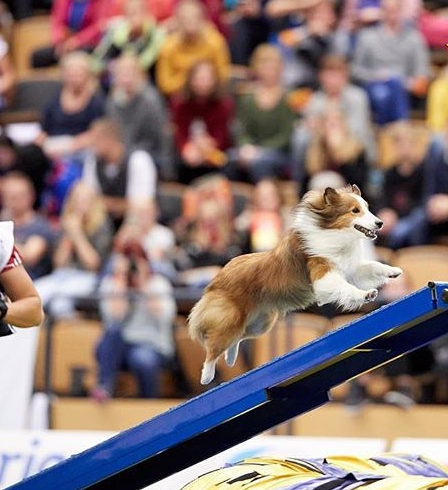
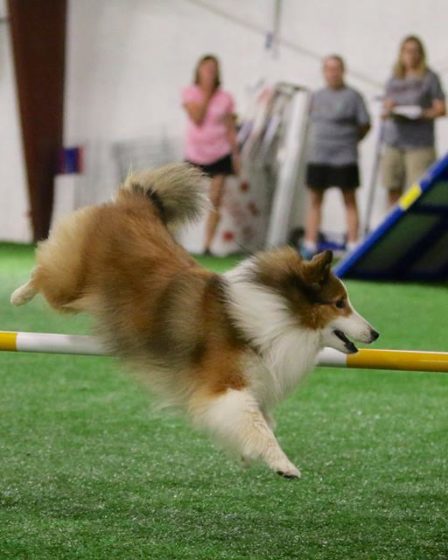
Jumping qualifies as a plyometric movement; this means it relies on generating a large amount of force in a short period of time. Within the realm of agility, these plyometric movements (i.e. jumping and contacts) require landing from a height which places a large eccentric strain on the dog’s muscles. Eccentric contractions cause more damage to the muscle than concentric contractions. Absorbing a large amount of force repeatedly within a training session causes significant damage to the dog’s muscles; more so than running, turning or weaving. These activities require less force to be produced by the muscles than jumping, which allows for a quicker recovery period. Now, let’s be clear. Muscle damage is necessary to produce muscle growth. Muscle damage does not result in injury unless we do too much of a movement too often. To regulate the amount of damage to the dog’s muscle fibers caused by plyometric movements, I track the volume and frequency of plyometric movements throughout our training week. 

When tracking volume for walking, we count miles. For plyometric we count the number of times the dog is required to land. For example, Flash, a novice dog, takes about 36 jumps per training session. When tracking volume we need to understand the minimum effective volumes and maximum recoverable volumes of a training session. In other words, a minimum number of jumps to stimulate a performance increase and a maximum number of jumps before overtraining occurs. The 36 jumps Flash does in practice meets the minimum amount of volume required as it closely represents the number of jumps Flash will see in competition. This stimulates a positive adaptation while not drastically exceeding the number of jumps required for competition that would result in overtraining. While 36 is not the magic number, we need to be intentional about how many jumps or repetitions over the contacts, particularly the teeter and a frame, our dog completes during training. 

Not only do we want to be mindful of the volume of plyometric movements within a single training session, we need to consider how often we train these movements. Due to the high amount of muscle damage that is caused by training plyometric movements our dogs need an adequate amount of rest before we train again. When we train our dogs their performance eventually decreases throughout the training session, we see this when our dogs get fatigued, slow down or make more mistakes than usual. With time for recovery they can train at the same level before that initial performance decrease. For example, at a show your dog may have three runs throughout the day. With a few hours of rest in between runs your dog can run at the same speed and perform just as well in the last run as in the first run. 

With time for recovery and time for adaptation, our dogs can train at a higher performance level than before. This is where we see technique, power and speed improve. To get these performance increases our dogs need longer than a few hours of recovery in between plyometric movements. Deciding how much recovery time is needed for your dog’s body to develop positive physical adaptations depends on how much volume, aka: how many jumps or contact repetitions, happened within the training session. For example, if Flash did 20 jumps – a low volume for what she is accustomed to and a low volume for what competition requires – a shorter recovery time, like 24 hours, would be appropriate. A larger training session, say 80 jumps or more,  might require 36 hours up to multiple days for recovery. This depends on your dog’s fitness level, what volumes your dog is used to, and the purpose of your training session. 

The volume and required recovery time help us determine how frequently we should train to best meet our dog’s physical needs. Training sessions with high jumping volume should be less frequent, while low jumping volume training sessions can happen more often. Training sessions without jumping or contacts, such as rewarding weave pole entries, flat work drills or other non-plyometric movements, can happen often due to the low recovery time required and can be used in between plyometric training sessions. Just as you tailor your training methods and handling style to meet your dog’s needs; how much and how often you train should be determined by what provides the best physical stimulus for your dog to stay healthy and perform better in agility.