Showing: 1 - 10 of 17 RESULTS
Dog Training Team

Reward Your Dog Better.

Dogs have preferences for food just like people! While true that some dogs will happily work for anything, most dogs have a favorite food. However, this preference may change week to week. Dogs know what is a “normal” treat and what is a “special” treat! While a dog may work for a normal treat, we may be missing the benefit of a special treat! When we communicate with rewards, we might not be communicating what we think we are or as well as we could with a different reward.

What Makes a Treat Special?

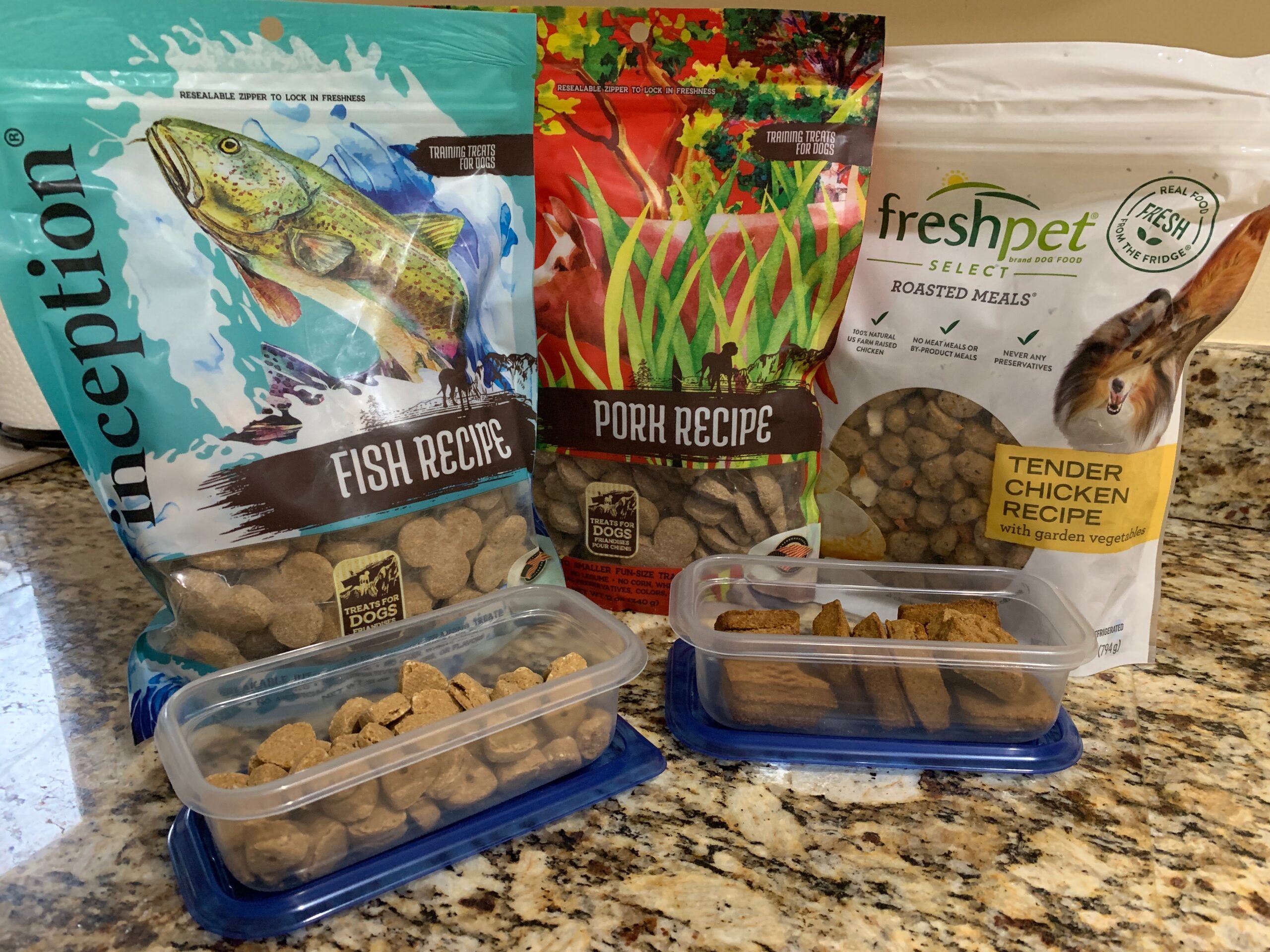
We have always encourage our students to bring multiple types of treats to a training session. Whether that’s homemade salmon cookies, roasted chicken, or the stinkiest treats money can buy, the more treat option you have the better. Most of our students know what treat is enough to keep their dogs’ attention. And, they know what treat makes their dog highly motivated to work. That second type of treat is worth it’s weight in training gold; we want to know what will kick our dog’s motivation into the next gear. Generic kibble might get your dog to cooperate, but using a treat that is new, stinky and desirable can keep your dog engaged. It’s a standing joke that whatever is in Diane’s pocket is of the highest value! Someone else’s cookies are almost always better after all.

As a matter of fact, t’s not just dog’s that have favorite treats…check out this Ted Talk excerpt with Dr. Frans de Waal which demonstrates reward preference and an example of a “higher value” rewards.

Explore Your Dog’s Treat Options

The underlying principle to shaping is there is a desire to earn the reward; so as trainers, it’s our job to motivate our canine partner with a desired reward! We recommend exploring your dog’s treat preferences to maximize the benefits of a reward. While two treat options is good, with a little bit of extra work we can have multiple treats available for our dogs to choose from. It’s an easy, fun way to engage our dog’s in their own development. You’ll never know when a novel reward might lead to a training break through, and we know having more options for rewards improves your training session quality.

Try it out and let us know what you discover about your pup!

Dog Training Team

For the Love of the Game

It’s heartbreaking to see your teammate stressed out, disconnected or shutdown mid-run. I’ve seen it happen with my own dogs and students’ dogs too. We want our dogs to love playing agility with us. This game is supposed to be fun for both of us. But, stress happens. Whether a team is training through chronic ring stress or a dog is suddenly insecure or unsure on course, there are many strategies we can use to support them. Being able to boost your dog’s confidence and help them cope with stress should be something every handler can do for their dog. So, here’s what I tell my students to do and how I set my own dogs up for success in even the most demanding trial environments.

Learn About Your Dog
Ask yourself when your dog loses confidence and struggles to focus on course. This is different for every dog, but there are a few common factors that contribute to ring stress. Possible factors range from your relationship with your teammate to the color of the judge’s mask. We’ll take a look at three common factors that are easy to recreate in training.

This starts off with the environment. The uncertainty of being in a new space around new dogs, smells and noises can create anxiety that shows up as our typical ring stress behaviors. My first suggestion for this is allowing time for your dog to sniff and explore the trial site. This is not an instantaneous fix. But, allowing your dog to become familiarized and comfortable in new environments can help them be more adaptable to new environments in the future. If your dog is fixated on the ring or nervous of certain areas move to a distance where they can focus on cues and physically relax. I recommend repeating this throughout the day to allow your dog multiple opportunities to understand their surroundings.

People are another factor I often see impacting a dog’s ability to stay connected on course. This can be people in or around the ring. The number of people and the proximity of a specific person, like ring crew, to your dog might impact their stress level and distractibility. If your dog always trains alone or with just one instructor in the practice field, stepping into a ring with half a dozen strangers might throw them off their game. A judge that follows your dog closely in the weaves or a crowd of people behind your dog on the start line can take up attention and energy that your dog needs to do agility . To help we can start including more people, new people and people in odd places when practicing. Our objective is not to overwhelm our dog, but to successfully complete a sequence or obstacle while a person is acting as a distraction.  At first, a person standing on the other side of the room might be distracting enough.  As your dog succeeds, you can begin adding multiple people and people in motion around the practice ring.

We often see ring stress occur before or during complicated obstacles, like weaves or the contacts, or during complex sequences. This is because these complex tasks require more concentration from the dog than they have to offer when over stressed. This type of issue is separate from obstacle specific issues; just because the stress appears before the weaves does not mean the weaves are the cause of the stress. For example, your dog pops the poles when the weaves are on the edge of the ring. The pop was due to a dog outside the ring walking by, but handlers will often focus their training solely on the obstacle. Believing their dog has poor weave poles, the handler never practices with moving spectators or distractor dogs. The popping issue persists. This is where failing to help our dogs appropriately cope with ring stress can intensify an obstacle specific issue. A dog that is continuously corrected for popping or continues to fail in the ring might develop stress specific to the weaves. Now, this is the exact spiral I want to prevent my students and all agility teams from experiencing. So, here’s what we do.  

We keep training and reinforcing your dog’s agility skills beyond what you’ll need in a trial. An increase in ability and consistently rewarding criteria can increase your dog’s competence with a specific task and boost their confidence in the ring. This type of progress takes time, and we can support our dogs by keeping it simple and keeping them successful in the ring. Skip the challenges you know they can’t do, we don’t want to set our dogs up for failure.  Don’t try to fix mistakes over and over, if your dog is distracted and stressed the best thing you can do is keep moving and find an obstacle they can complete successfully! If you are looking to train a certain issue, like avoiding an obstacle or start lines, in the ring you better be prepared to reward big. Choose your dog’s favorite toy and opt for FEO (For Exhibition Only) or NFC (Not For Competition) at your next trial. If your dog succeeds, party like 2020 is finally over. If your dog doesn’t succeed, find an obstacle or behavior that they can succeed at. Then, you guessed it, party.

Note: I don’t recommend parties for dogs with over arousal issues. Flash, a rehabilitated(ish) arousal junky, gets pets and quiet praise as a reward. Once she’s relaxed, we release her extra energy with tugging.  Arousal issues in agility really are their own topic for another day.

If you can recreate these confidence issues easily in practice, you may want to discontinue trialing for a period of time to stay in a more controllable environment. We want to practice agility in environments where our dog can still be successful.

Sniff Worries Away
No more “No, sniff!”. Sniffing is one of the main ways our dog’s gain information about their environment. If your dog is stressed due to noise, people, other dogs or whatever else, correcting and preventing sniffing can further increase their anxiety. Nothing makes stress more stressful than adding uncertainty to the situation. Sniffing provides our dog’s with useful information and can make an environment feel more familiar. Our goal shouldn’t be to eliminate sniffing, rather give your dog adequate time for sniffing before you need them to focus on agility.

Take time to let your dog explore and sniff their way around the trial site. You can even encourage sniffing by putting it on a verbal cue, we say “Go Sniff, Sniff”, or doing a small treat scatter (far, far away from the ring). The scents around the ring are similar to what smells will be on the agility course too.  This helps desensitize our dogs to smells in the environment that might be distracting upon first sniff, sniff.

Build a Connection Behavior
What will you do if everything goes wrong? Your dog yawns on the start line or starts sniffing at the weaves and you need a way to reconnect with them. Asking them to “Come” or calling their name doesn’t create enough motivation or instruction for your dog to re-engage with you. Typically, this is because verbal cues like “Come” and “Fido” lack specific criteria and the strong reward history we need. We might say our dog’s names three dozen times a day with no reward or purpose. When we get to the trial, our dogs simply don’t understand the behavior you expect when calling their name. Instead we need to choose and use cues that are specific, easy and always rewarded. These should be behaviors that are enjoyable for our dogs. Using a hand touch, spin, or asking for your dog’s favorite trick can give your dog an easy win and help them re-engage with the game of agility.

Here’s the deal – you need to practice using your connection cue. Whether you’re at agility class or at home, whenever your dog makes a mistake or disconnects use your connection cue and reward it. Jackpot it, have a party about it. Use the best cookies and their favorite toy. Work your tail off to make this connection behavior an utter joy for your dog to complete.  This is the only way for a connection cue to make a meaningful difference in a trial environment. Quite simply, you gotta train it if you wanna use it!

Be a Proactive Handler
When you know you’re going to encounter a distraction, craft your handling plan to support your dog best throughout the run. This is different for every team – here are some examples of proactive handling might help you and your dog.

1) You may find staying closer to your dog boosts their confidence. You can choose to avoid long lead outs and distance on course. You can also use yourself as a buffer between your dog and a distraction. If the weaves are along the fence with teams waiting to run, pick a handling plan that puts you between the weaves and the fence. You’ll add support by being close to your dog and provide a visual barrier between your dog and the other teams watching.

2) Change how you use your voice on course. Mostly, this means managing your tone. High pitched or squeaky noises from you can trigger anxiety in your dog. Yes, they can hear the panic in your voice. To help, keep your voice deep and clear. You can also increase verbal support by using clear reward markers, like “Good” and “Yes”, throughout your run. However, we do want to avoid useless chatter, “Good dog, let’s go, hurry. Okay, Fido, here we go, tunnel.” Adding extra words without intention can distract your dog from information they actually need, like what obstacle to take next!

3) Plan to use your connect cue before your dog disconnects. If your dog consistently runs around the weaves on the first attempt, as you approach the weaves you should use your connection cue to keep them on task. While this might not guarantee a perfect set of poles, you’ll start to interrupt the run-by behavior. A connection cue with strong reward history (i.e. always rewarded) should help you alter your dog’s association with the weaves and give your dog the best chance at success in the ring.

To those of you on this training journey, it’s a process. It will take time. You will make a mistake, or two, or three. Please, be gracious with yourself and your dog. In the end you’ll be a better dog trainer and you’ll strengthen your relationship with your dog. We can teach them how to love this sport as much as we do.

Team

Jumpers Run Review

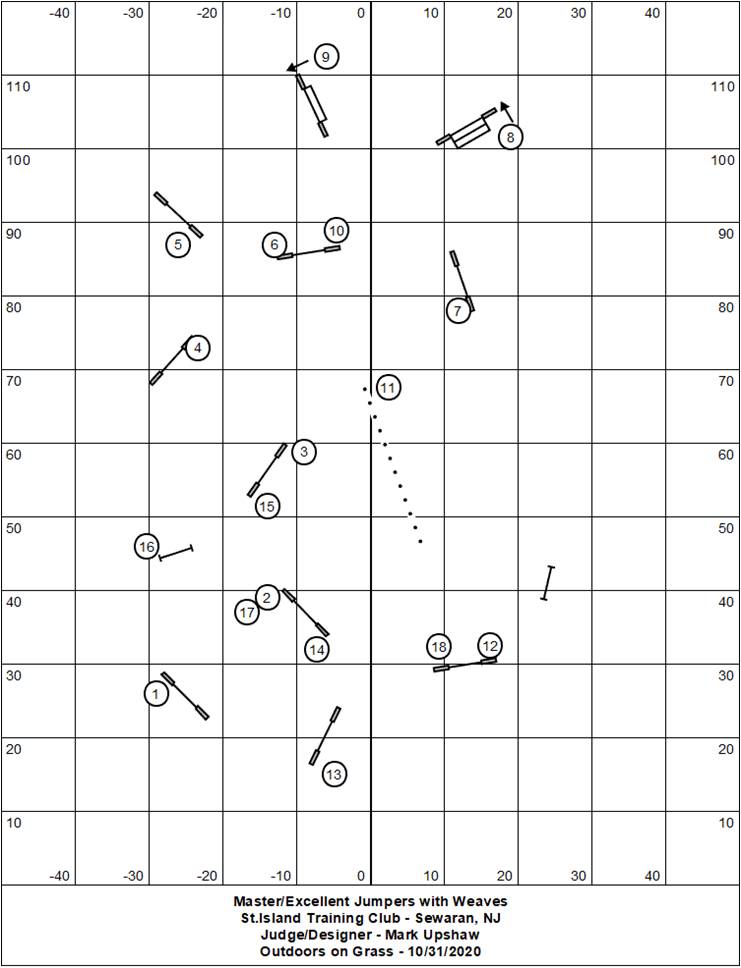
This past Saturday, Zabu and I ran an AKC Ex/Master Jumpers course judged and designed by Mark Upshaw. We were outdoors on grass, which was soggy from two days of continuous rain. The course was built a bit differently than the map due to footing which also had a few dips and inclines. It was, however, a lovely course with lots of handling options and big spaces between jumps.

Throughout this article, I’ll be breaking down how I analyzed my handling choices before and after my run on this course! I always start by identifying my goal for the event and our current training issues, we call these The Magic 5. Then, I can decide on handling in my Pre-Run Analysis and review our performance with a Post-Run Analysis.

In our methodology, local trails are an extension of training, not the end goal; so I go into every trial looking for training opportunities. Zabu’s “Magic 5” were in my mind as I reviewed each course map. Her primary training issues this month are (1) lacking consistency on her seesaw performance from training to trialing, (2) understanding blind crosses and (3) tighter wraps with me in different positions. For a masters level AKC course, I was primarily looking to test and use some of our blind cross training.

Pre-Run Analysis

My walk-thru process is…

1 – Walk the Dog’s Path
This let’s me look for soft spots, dips or other obstructions on my dog’s path I can see potential off courses from the dog’s perspective, and this will help me memorize my handling plan later on.

2 – Consider handling options
Do I use mostly Rear Crosses (RC) which worked well for the 12″ dogs OR do I use mostly Blind Crosses (BC) which is what Zabu has been training the past month?

I chose BCs – though the riskier choice – it is what Zabu has been training.

3 – Plan Out Handling & Cues
Now, I can decide on the specifics of my cues and walk my handling plan for entire course. This means plotting out distances, adding verbal cues for support and imagining the timing of my crosses.

The Plan
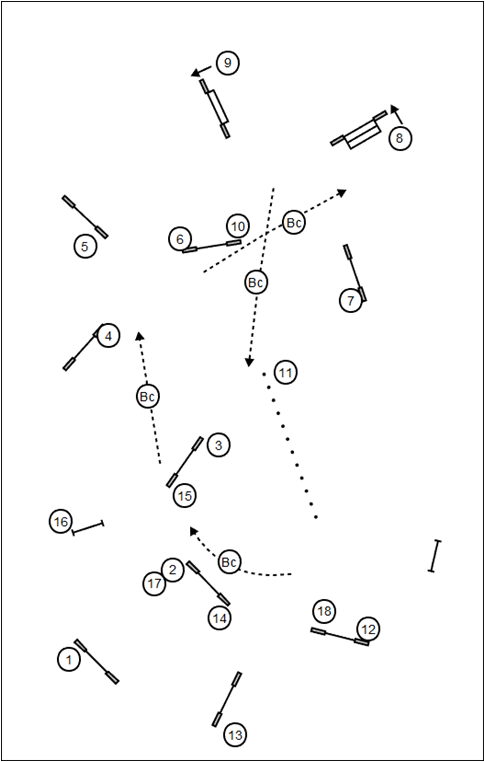
Send “Out!” to jump 2. Run ahead to BC between jumps 3-4. Send “Out!” to jump 5, then run ahead to BC between jumps 6-7. Send “Out!” to jump 9, and BC between jump 10 and the weave poles. Send “Out!” to jump 13. Run ahead for BC between jumps 14-15.

Intended Handling Plan

5 – Film My Run!
Find friend to video run. I am hoping to see how my current training criteria holds up in a competition. I definitely want our run on film to review both my performance and Zabu’s.

Post Run Review

My post-run analysis is to look for miscommunication between Zabu & I and, at each point, decide whether the problem occurred due to my “plan” or the “performance”. Not only do I think back on how the run felt, I watch my film to analyze our teamwork throughout the run.

Zabu – Video of Course Run

The Plan In Review
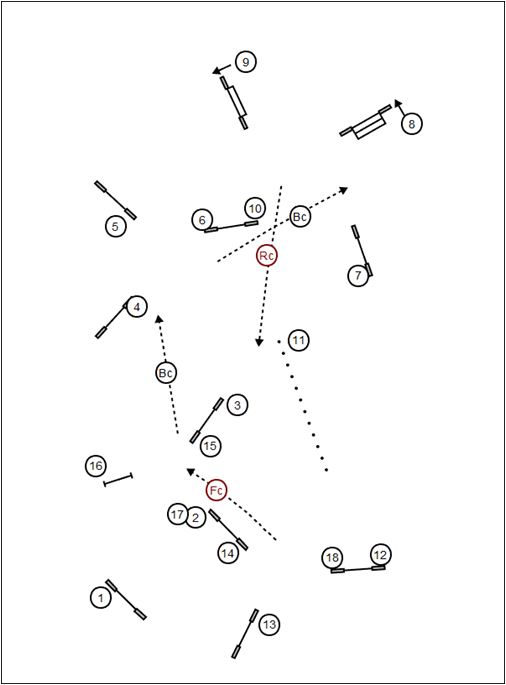
The send “Out!” to jump 2 worked well, I got ahead to my BC easily. The BC between jumps 3-4 didn’t work; the plan felt good, but Zabu did not connect with me on the new side. Due to this bobble, we skipped our send “Out!” to jump 5 and then the BC between jumps 6-7. However, we got back on the plan by jump 9 for our Send “Out!”. The BC between jump 10 and the weave poles worked, but created too much speed for her weave entry. With Zabu being young, a rear cross may have given her more time to see and collect for her weave entry. I sent “Out!” to jump 13, but I was late on the execution for the BC between jumps 14-15. On second thought, a Front Cross (FC) might have worked better to set up the turn to the end line.

Revised Handling Plan

My take-aways for future training and trialing:

 1 – On film, it looks like Zabu is chasing my right foot/leg for the first BC. This is a “game” we play; to fix this I need to stop letting her tug on my pants/shoes.

 2 – I need to remember that with more trial experience she has picked up considerable speed so a FC or RC will be better choices to control lines where she needs a collection stride.

 3 – On video, I obviously slow up at jump 18. It did not affect her run, but it’s a bad habit of mine!

With this review I not only understand why faults may have occurred, I also have actionable solutions for future handling plans. I can continue working on our main training issues, while being more conscious of how to best support Zabu’s performance on course.

Team

What I know about Recovery

S’more lost her nail last Monday.

Once we had a game plan for helping S’more’s nail grow back, I shifted my focus to the other ouches. Ripping off a nail probably requires a good deal of force, meaning she yanked her whole front, left leg pretty hard. And, sure enough, her shoulder, bicep and chest were giving off heat. I do know this means more blood flow being directed to those muscles to help repair damaged tissue. I don’t know the specific muscles, tendons or ligaments that would have been impacted by such a yank. I also don’t know what direction she yanked. Pulling the leg back or yanking away while the leg is in front; these different positions change how the muscles and connective tissues were impacted.

Long story short, I don’t know how she did it or when she did it. I know two things: 1) that probably hurt and still hurts & 2) we’re now in recovery mode.

Now, it’s important to note that at no point did S’more limp and she was not in excessive pain. If so, we would have taken additional steps to see if there was any damage to the bones or tendons above the nail.

When we encounter a minor injury, like a ripped pad, broken nail or are really sore – like after a big weekend of hiking, our dog’s need extra recovery time. But, recovery doesn’t just take time. I do my best to use that time intentionally to help my dogs (or, myself) heal properly and regain normal functioning. The following activities are what I have been including to help S’more recover and get back to agility. Every injury is unique; the structure of the dog, the accident, the chronic wear n’ tear, and so, so many other factors come into play. These are the general guidelines I follow for my own dog’s recovery and, to some extent, my own recovery as an athlete.  I am always learning more, reflecting on past mistakes and trying to do my best. If you need help with your own dog or want to learn more, I encourage you to work with a physical therapist or veterinarian that specializes in dog sports and sports rehabilitation.

Recovery Guidelines

1. I don’t ice.

Ice restricts blood flow from reaching damaged tissue. Blood flow brings in necessary materials for repairing damaged tissue and takes away by products of the recovery process. Icing can kill red blood cells as they arrive and those damaged cells pool in the injured area. This can increase the time to recovery. I would only ice under special circumstances when prescribed by an expert that specializes in dog sports rehabilitation.

2. I use active recovery methods.

Active recovery means using movement to encourage blood flow to and through damaged tissues. Typically for my dogs this includes active stretching (i.e. dog moves themselves into different stretch positions) and walking. For people, light strength training, biking and swimming can also be great choices. These are a bit harder for a dog and we need to manage the dog’s intensity. Active recovery activities should be low intensity; no fetch, no spinning quickly, no jumping, no landing, no sprinting, and no pulling.

I keep all our activities low intensity until our initial injury is healed.
For example: A lose leash walk is a very different physical stimulus than pulling the owner down the street or breaking into a run. Pulling in particular should be avoided – always. Not only is your dog likely pulling significantly more than their body weight, they’re likely pulling from a non-advantageous position depending on your collar or harness choice. Overtime, this can add strain to already sore and damaged muscles and cause muscular imbalances.  I always bring treats on walks to encourage my dogs to keep a loose leash, and reward my dogs for continuing forward rather than tugging them forward. With lots of squirrels in the neighborhood and a bored border collie, this is a challenge. But, it is worth every cookie to keep S’more walking calmly and at an appropriate pace.

I incorporate active stretching multiple times a day during recovery. Using treats I ask my dog to move into different positions to extend and stretch certain muscles. Overtime, active stretching can increase mobility – the ability of my dog’s joints to move through a full range of motion. This involves moving slowly into different positions relying on the body’s ability to move safely into a position. This means the dog is actively using muscles to stay balanced and maintain coordination while expressing flexibility. This can help increase range of motion and prepare the body to use those muscles and joints in activity.
Yes – I do active stretching before agility for myself and my dog.

3. I use passive recovery methods.

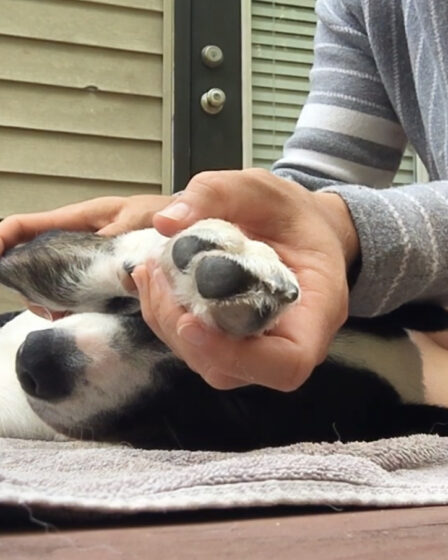
Passive recovery means an outside force (aka: you or another human) are manipulating the dog’s body. This can be massage or stretching which also brings blood flow to and through the damaged tissue. 

When I massage my dogs I use a very light pressure on their muscles and watch for signs of distress (i.e. fussing, licking or staring at me). I try my best to massage in the direction of the muscle fibers – you wouldn’t massage your calf muscle left to right, you massage up and down. Also, I never “dig in” with my fingers.

When I passive stretch my dogs I use a very light pressure to move their limbs and watch for signs of distress (i.e. fussing, pulling the leg away or staring at me). My objective is to work my dogs’ legs through their current range of motion. This means moving into extension, flexion, abduction and adduction for different muscles. I focus on the shoulder joint and hips; which involves dozens of muscles moving into all these positions.

This may not always be what you consider as “full” range of motion – if injured or tight, your dog’s tissues may not stretch to their normal abilities. Just like my ability to touch the floor often depends on the tightness of my hamstring muscles. Someone else forcing my body into over extension or flexion risks tearing or straining the tissues around my hip joint – not good for humans or dogs. Moving the leg into a position that my dog is comfortable with is the goal during passive stretching. This can sometimes be a farther range of motion than they can reach on their own with self stretching. Overtime, I can increase and/or maintain flexibility of my dog’s muscles and connective tissue.

I do not use passive stretching before activity or agility – but I do use passive stretching directly after exercise and always after an agility day. After massage or passive stretching, I always offer my dogs lots of water or give them a hydrating snack (like watermelon). Extra fluids will help their body process any of the damaged cells that are moving away from injured areas.

4. I look for indications of improved well-being.

This might include self stretching through improved range of motion, relaxing during massage or passive stretching, or more mobility in active stretches. While I wait for the nail to grow back, I also want to see some of the additional soreness or tightness to dissipate. This took approximately 7-8 days for S’more. If I don’t think it was “that bad” or that she wasn’t in “that much pain”, why would it take over a week for her to feel better?

5. I recognize that compensation and in-activity lengthen recovery time.

Compensation means your dog is putting more load on other muscles to complete activities, like shifting your weight from one leg to the other when standing. This is fairly clear when your dog is limping; the uninjured legs are doing WAY more work and these dysfunctional movement patterns are costly. So, when I put a sock on S’mores foot I am forcing her to compensate because socks are evil and she doesn’t walk normally. While this is necessary to keep her toe clean, it also means I need to limit her activity as much as possible. The same goes for a cone or other instruments you’re attaching to the dog to aid in the healing process. If it changes how your dog holds their head or moves their legs you’re likely going to see additional soreness in places other than the initial injury site due to compensation.

To minimize in-activity I focus on activities throughout the day that drive blood flow to the injured area – like the passive and active recovery methods mentioned above.

6. I spend equal amount of time recovering as I do coming back to sport.

 For S’more, I anticipate we’ll have a full nail by the end of the week. That’s about 15 days in recovery, and we’ll spend 15 days coming back to agility. This means that she will not be on full height equipment or running courses until then. For now, we’ll keep “agility sessions” short focusing mostly on foundational movements; working technique at a slow speed and no jumping. I’ll be spending time passively stretching and massaging her foot to help any muscles or connective tissue that were impacted by the nail being ripped or yanked off.  And we’ll be focusing on mobility (using active stretches) and strength training (using our core work exercise – you can find experts for that too!) to get back to agility safely.

I know that S’more has not lost her ability to do agility. She is plenty fit, and two weeks of rest doesn’t deteriorate that much muscle. But, gradually coming back to sport decreases the likelihood of reinjuring the toe or another part of her body.

For major injuries, surgery or a longer break from agility, more time is needed to bring the dog back to sport safely.

Now, here’s the real secret. These recovery techniques aren’t just for recovering from minor or major injuries. Using recovery techniques every day can help your dog improve their fitness, reduce risk of future injury and may increase their longevity in the sport.
Attitude Competitor

Leash Your Focus

“Tunnel! Go tunnel!” You’ve sent your dog into the last tunnel and are well ahead for the four jump end line. As your perfect run becomes three jumps and then just two, you begin enthusiastically waving to your friends sitting ringside and then crack a joke to the judge. Sound truly outlandish? Absolutely! You would never focus on friends or the judge while your dog is running on course. You know how important it is to keep your focus on your dog.

What do you focus on right before your run, during the walk through, or while you were driving to the trial?

As a competitor, your thoughts are important and how you use your attention matters. You do not want to waste time and energy focusing on things outside of your control. Every weekend we see our students spend their time and energy on things they cannot control like the running order, course design, weather, trial schedule and results. 

Now, you might feel like some of these challenges warrant your attention and you’re not wrong as long as you use your attention responsibly. Attention is one of your most valuable resources. During a trial day, attention is a combination of your time and energy; mental, emotional, and physical.

Many handlers spend their attention on the uncontrollable – panicking about being first in the running order, fussing about potential ring conflicts, complaining about the course design, or stressing over the results. When your reactions and thoughts are not managed, you are using your attention frivolously. Stress, complaining and focusing on problems that don’t have solutions is costly and will leave you feeling mentally and physically drained. You need to save your attentional resources so you can focus on your teammate and your runs.

To use our attention responsibly, we need to be response-able. This means focusing on the problems that are within our control and for which we can create solutions

For instance, when you’re first in the running order, you can control your time by warming up your dog before the walk-through. When the course design is unappealing or seems dangerous, you have choices within your handling plan or you can talk directly to the judge about a change or you can make it a training run. When you feel stressed over the results, how many points you earned (or didn’t) or where you placed in a round (or didn’t), you can control your attitude and can create new training goals to work through frustrating results. 

All of these examples and many more are positive responses to events and thoughts. Focusing on what you can control ensures the time with your dog will be rewarding and fun. 

Coaching

Coach’s Corner: Using Video

For the last several months, I have changed my private lesson format to include a video of every sequence and many drills. While having lots of video can often lead to analysis paralysis, using video doesn’t have to lead to wasting time and being overwhelmed. There are multiple advantages to video during the lesson and as a resource for your students later on. This article breaks down the benefits I’ve found of using video throughout a lesson or class.

Same Perspective
Our first goal is to have the instructor and student view the performance from the same perspective. If a picture is worth a thousand words, then video is worth a hundred thousand. By using the I-pad screen, I can watch the video with my student or small group to analyze specific sections of a course. Reviews highlight areas of success and spots that may need adjustments. With slow motion reviews, discussions are more than just the instructor’s opinion of a run. Playing things frame by frame lets students see the nuances of handling that the coach’s experienced eye picks up on easily. This is particularly true when the issue is timing or distance related. 

Immediate Feedback
Review discussions also happen within a minute or two of the actual activity – sequence or drill. This immediacy of the review allows for the discussion to happen while the student can easily relate the “feeling” of the motion or position to what they see on screen. It’s a “fresh” memory and easy to relate too. And, better yet, using a visual, like video, can increase a handler’s spatial awareness when completing a specific move or sequence. Students can make a correction or adjustment to their handling and watch the new video and the corrected “feeling” to see the difference.

Capture the Best
Once home, my students review their problem areas again and can get a superb comparison of the fix or adjustment. One of the largest advantages of having a video library is keeping and re-watching the best performances. The rule is “watch the mistake, delete it and then study the correct performance over and over.” 

Collect Micro Data
Post lesson video analysis allows for micro data collection. This includes small data points throughout your run that influence your performance. Like times for an obstacle performance such as weaves, dog walk or teeter or times for a which-way drill. This information can be used to make decisions about handling paths in the future, or as a reference point for tracking your dogs improved fitness or skill efficiency. 

Once you have a collection of micro data points you can compare your performance at home with videos from competition. This allows you to identify differences in performance in the different environments. Now, you can more creative with your proofing drills or change up your trial schedule or routine to work on a specific issue.

Kathleen & I highly recommend other coaches adopt using video for more than just online agility lessons or classes. The list of benefits for agility goes beyond what I’ve listed above. Bottom line – video data is invaluable when used and when used correctly.

Dog Training Team

Training Principles for Success

I believe that how you train is just as, if not more, important than what you train. How we communicate, support and reward our dogs throughout a training session has an impact on what our dogs learn and how they perform. These are the three principles I follow in my own training to ensure I create a positive learning environment for my dogs.

Always Train in a Good Mood
Your dog is going to need your full support on course to understand their job, and if your dog is still in training your support is critical for their success. Coming to a training session in a bad mood or training while distracted by other problems does your dog a disservice. You should always bring your best self to training; and I know, this can be easier said than done.  Taking a moment to clear your head, plan and set expectations for an upcoming training session is a good step to set yourself and your dog up for success.

Never Fail More Than Twice
When challenging a concept I want to see my dog make mistakes and think through each new challenge. This is how their understanding of a behavior grows. However, I do not want to see my dog frustrated or discouraged. Failing over and over again does just that for most dogs. After the second failure of a skill, I always add more support (e.g., moving closer during a distance drill, luring with your hand, slowing down) and reduce the difficulty back to our last successful attempt.

End with Playtime
Dogs have been shown to retain information better from training sessions when they also engage in a short play session (approx: 5 minutes). This is a bonus for training new skills, and there are huge benefits for our team development. Through play you can learn more about your dog. Consider what toys they like, what noises they find funny or scary, and how they reaction to motion? All of this information will be important throughout your agility career. We’ll gain useful insights about how to better communicate and support our dogs on and off the course from engaging in thoughtful play. We are also reinforcing ourselves to keep training sessions positive and fun; remember we always train in a good mood.

Athlete

Debunking Handler Fitness Myths

By Kathleen Oswald MS & Adam Whisler, MS, CSCS, TSAC-F, CISSN, USAW

As an agility handler your job is to run alongside your teammate while using body language and verbal cues to give directions. Being fitter and faster can make it easier to handle your dog on course and increase the number of handling options that are available to you. For this very reason, fitness is becoming a priority for many handlers. But, getting fit for agility isn’t as simple as it sounds. Finding workouts online or even hiring a personal trainer can be a great start to improving your health, but these resources may lack the understanding of dog agility needed to really take your fitness to the next level. In this article, we’re going to break down three myths about fitness for agility to help you better understand exercises that will actually be beneficial for your fitness goals!  

Myth #1: You have to “be a runner” to get faster 

Most people define “being a runner” as doing a 5k or farther. Running a 5k or longer distance doesn’t provide the body with a similar physical stimulus as a handler will find when running an agility course. Running far requires the body to develop slow-twitch aerobic muscle fibers, whereas the speed and change of direction seen when handling in agility requires the development of fast twitch anaerobic muscle fibers.

So, what does this mean?

By running long distances you’re developing the opposite muscle composition of what you need to be quick on course. This is not to say that running would not improve handler speed due to increased lean muscle mass, weight-loss or improved overall health. Running for distance is simply not the best or most necessary exercise to improve your handling abilities. 

Myth #2: Agility ladders increase your speed and agility 

The agility ladder as an athletic training tool does not improve agility or speed. Agility, as an athletic skill, combines your ability to accelerate, decelerate and change direction. Throughout ladder drills both speed and direction are constant; there is no acceleration, deceleration or change of direction. By design this tool does not improve your ability to run fast and change direction quickly; it does improve your ability to learn footwork through a ladder drill. By practicing a variety of ladder drills at increasing speeds you will get faster and increase coordination, but this doesn’t transfer well to dog agility.

Ladder drills simply do not represent the physical components that dog agility requires.

A handler needs to be able to accelerate quickly, decelerate quickly and move through multiple planes of motion – in other words, not just run in a straight line, but move forward, backward and diagonally. Best to leave the ladder out of your workouts if your real fitness goal is to beat your dog down the line for that blind or improve your footwork through front crosses. 

Myth #3 Strength training hurts running performance. 

The common misconception is that strength training will cause you to bulk up and get weighed down by all that extra muscle. This is not the case as weight gain and loss is determined mostly by your caloric intake, not by what exercise you do. Rather, with strength training your body will undergo recomposition where you lose body fat and gain lean muscle mass. Strength training increases your ability to produce force – your ability to produce force in a short period of time is exactly what will make you quicker on course.

It does this by increasing the strength of your muscles, tendons, ligaments and joints through loading compound exercises that emphasize full ranges of motion. Handling puts a large strain on our tendons, ligaments and joints due to the quick change of direction, acceleration and deceleration required of handlers. We’ve likely all seen more than one of our fellow agility competitors injured due to the high physical demand of our sport. Strength training can minimize your risk of injury and increase your handling performance on course by enhancing your overall health and ability to change direction and run faster while staying balanced. 

Dog Training Team

Jumping Into Plyometrics

My goal for agility is to train to a competitive level while minimizing the number of injuries my dog sustains throughout their career. This year I retire my 10 year old, former world team dog and simultaneously have begun training my 18 month old in agility. Whimzy had a highly competitive career at 16” and never had a major injury. Competing a dog often over multiple years and staying healthy can be quite the challenge as agility is a high impact sport. Our dogs run hard and their bodies absorb a lot of impact on landing. By incorporating core workouts and cross-training, like hiking, we can increase our dog’s overall fitness and reduce their risk for injury. Handlers around the world have embraced the concept of additional fitness training for our canine athletes. But, this isn’t the only fitness concept we should be bringing into our agility training. What we train, how much we train and how often we train has a direct impact on our dog’s overall health and performance in agility. It is up to us, the handlers and trainers, to structure training sessions that positively benefit our dog’s health and subsequently improve our dog’s performance in agility. The following article outlines what I consider when planning for agility training and recovery. 

Jumping qualifies as a plyometric movement; this means it relies on generating a large amount of force in a short period of time. Within the realm of agility, these plyometric movements (i.e. jumping and contacts) require landing from a height which places a large eccentric strain on the dog’s muscles. Eccentric contractions cause more damage to the muscle than concentric contractions. Absorbing a large amount of force repeatedly within a training session causes significant damage to the dog’s muscles; more so than running, turning or weaving. These activities require less force to be produced by the muscles than jumping, which allows for a quicker recovery period. Now, let’s be clear. Muscle damage is necessary to produce muscle growth. Muscle damage does not result in injury unless we do too much of a movement too often. To regulate the amount of damage to the dog’s muscle fibers caused by plyometric movements, I track the volume and frequency of plyometric movements throughout our training week. 

When tracking volume for walking, we count miles. For plyometric we count the number of times the dog is required to land. For example, Flash, a novice dog, takes about 36 jumps per training session. When tracking volume we need to understand the minimum effective volumes and maximum recoverable volumes of a training session. In other words, a minimum number of jumps to stimulate a performance increase and a maximum number of jumps before overtraining occurs. The 36 jumps Flash does in practice meets the minimum amount of volume required as it closely represents the number of jumps Flash will see in competition. This stimulates a positive adaptation while not drastically exceeding the number of jumps required for competition that would result in overtraining. While 36 is not the magic number, we need to be intentional about how many jumps or repetitions over the contacts, particularly the teeter and a frame, our dog completes during training. 

Not only do we want to be mindful of the volume of plyometric movements within a single training session, we need to consider how often we train these movements. Due to the high amount of muscle damage that is caused by training plyometric movements our dogs need an adequate amount of rest before we train again. When we train our dogs their performance eventually decreases throughout the training session, we see this when our dogs get fatigued, slow down or make more mistakes than usual. With time for recovery they can train at the same level before that initial performance decrease. For example, at a show your dog may have three runs throughout the day. With a few hours of rest in between runs your dog can run at the same speed and perform just as well in the last run as in the first run. 

With time for recovery and time for adaptation, our dogs can train at a higher performance level than before. This is where we see technique, power and speed improve. To get these performance increases our dogs need longer than a few hours of recovery in between plyometric movements. Deciding how much recovery time is needed for your dog’s body to develop positive physical adaptations depends on how much volume, aka: how many jumps or contact repetitions, happened within the training session. For example, if Flash did 20 jumps – a low volume for what she is accustomed to and a low volume for what competition requires – a shorter recovery time, like 24 hours, would be appropriate. A larger training session, say 80 jumps or more,  might require 36 hours up to multiple days for recovery. This depends on your dog’s fitness level, what volumes your dog is used to, and the purpose of your training session. 

The volume and required recovery time help us determine how frequently we should train to best meet our dog’s physical needs. Training sessions with high jumping volume should be less frequent, while low jumping volume training sessions can happen more often. Training sessions without jumping or contacts, such as rewarding weave pole entries, flat work drills or other non-plyometric movements, can happen often due to the low recovery time required and can be used in between plyometric training sessions. Just as you tailor your training methods and handling style to meet your dog’s needs; how much and how often you train should be determined by what provides the best physical stimulus for your dog to stay healthy and perform better in agility.

Competitor

Trialing During COVID-19

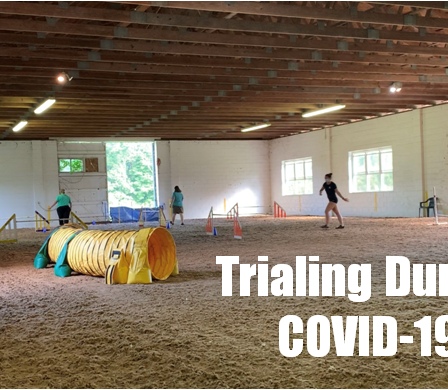
We had a positive experience at our local AKC show, hosted by the Krusin’ Kanine Agility & Dog Sports Club. This was my first trial since COVID-19 hit the United States, and its a whole new way of doing dog shows. I’d like to thank the volunteers and club members that went the extra mile to organize and run a dog show while being as safe and health conscious as possible. This post is going to walk through what our trial day was like for anyone curious about how things have changed. Thankfully, running courses with our dogs was just as fun as ever. 

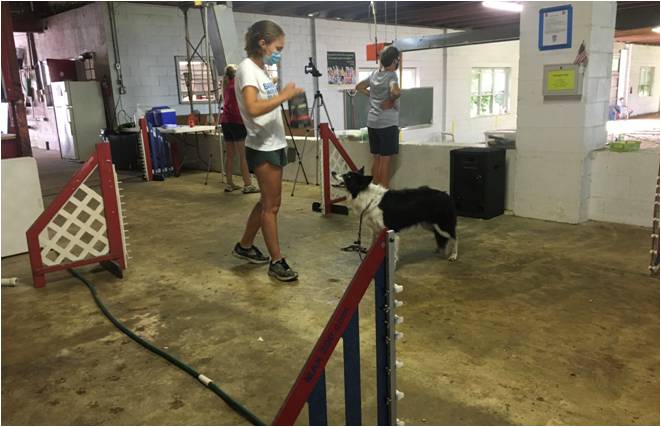
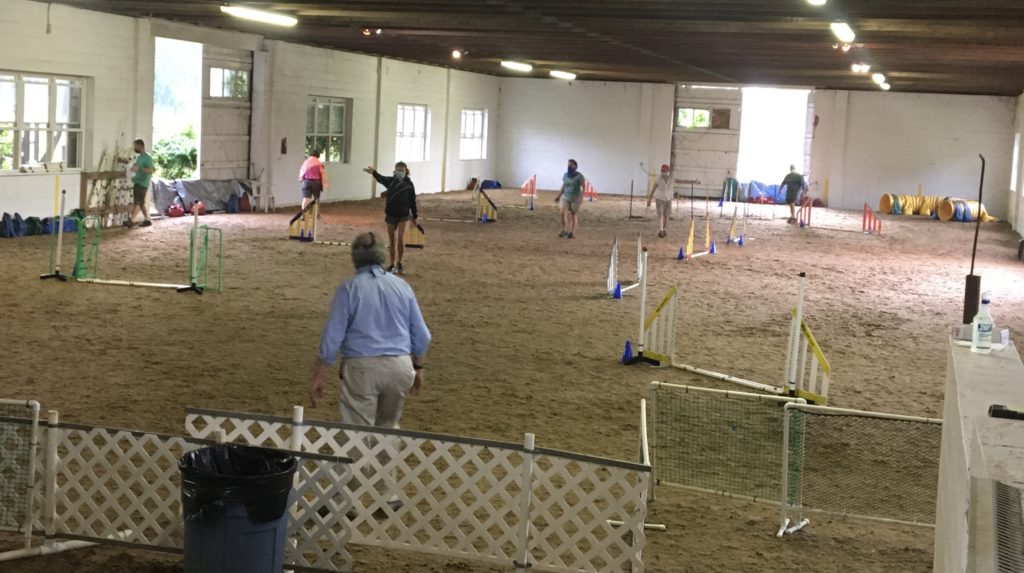
We gathered for the briefing outside the building, with everyone in masks and while practicing social distancing. The judges explained the new regulations, such as wearing your mask into the ring and the option to carry your leash. We had a contactless check-in with the gate, and a series of split walk through limited to about 10 people per group. While this took a while, the small groups made it exceptionally easy to social distance during the walk through. 

Volunteers wore masks and gloves to touch obstacles and the materials for score keeping. In between classes, volunteers sanitized the obstacles before the next group of volunteers entered the ring for bar setting and course building. A club member also took the time to set up a live stream on Facebook for us to watch our friends as no spectators were allowed in the building. 

Competitor lined up in a waiting box before their run.
Split walk-throughs to encourage
social distancing

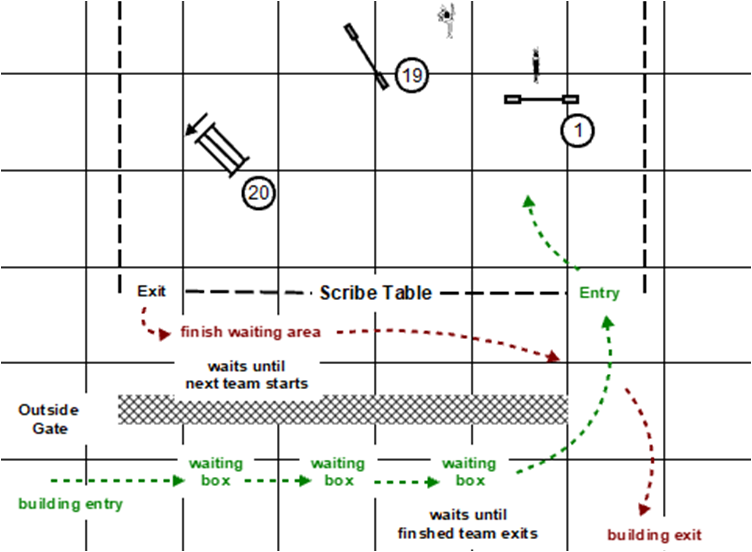
Before our run, the gate steward lined up competitors five at a time. Each competitor progressively moved through pre-set waiting boxes to ensure social distancing as we approached the ring. When the dog before us left the start line, the previous dog and handler were invited to leave the building. And then, we were invited into the final staging box before our run. Here, we waited for the dog before us to leave the ring where they would wait in an exit area until we’d left the start line. While it sounds complicated, volunteers did an exceptional job directing traffic to ensure handlers kept their distance from one another. 

Example of Competitor flow around the ring
Green Path shows teams waiting to run, and
Red Path shows teams that have finished.

We were not required to wear our masks in the ring, but carried our masks with us during our runs. We had the option of wearing/carrying our leash or having the leash runner move it to the end. The leash runner used a grabber which was sanitized between runs to limit contact with leashes. 

After our run, we were invited to leave the exit area and collect our items (i.e. coats, treats, toys) before exiting the building. With two entrances to the building, the handlers leaving were directed out a separate entrance from where competitors were lined up for their turn.

In between runs we spent a lot of time chilling in our cars outside. While this made for a quiet and unique trial experience, it was an absolute pleasure to see familiar faces, even under masks, and run my girls in agility.