Showing: 1 - 6 of 6 RESULTS
Attitude Competitor

Believing In Your Team

I know, I know. Easier said than done.

The truth of it is that there will always be reasons to doubt your abilities or your dog’s potential. You won’t always feel supported. You won’t always get back the effort you put in. You won’t always receive the validation that you feel you need. You won’t always feel that your team is “ready” for the opportunity before you.

Those feelings and thoughts are a part of everyone’s agility journey at some point in some way. To work through the discomfort of self-doubt and to give your best effort in the face of unknowable outcomes is part the journey. To survive those feelings and learn to thrive despite the odds you need to cultivate a sense of belief in yourself and your dog.

If you’re struggling to believe in your team, check out the daily drills below to help you change and strengthen your beliefs.

1. Write Out Your Reasons to Believe

⭐️ 5 reasons your dog is a great a teammate.

⭐️ 5 reason you’re a great teammate for your dog

⭐️ 5 reasons you and your dog are a great team

Go big, go small and list every reason in between. Often handlers struggle to see the “evidence” that they’ll be successful in reaching their goals, training this dog or being the type of handler their dog deserves. It’s much easier for your mind to focus on what you’re lacking, rather than acknowledging how far you’ve come and all you’ve gained so far.

This listing activity helps you build evidence that you, your dog and your team are worth believing in. This exercise should be done daily or weekly to gain the most benefit.

2. Set Process Goals

If you’re struggling to see your teams progress or don’t feel that you’re getting results you want, this drill is for you. A goal can be “results oriented” or “process oriented”. Results are often out of our control; someone else can have a better performance, the judge makes a bad call or the weather just fucks up everything. For this reason of uncontrollability, results oriented goals can cause more frustration than inspiration.

A process goal focuses on actions or tasks within your control that you can always succeed at completing as long as you put in the effort. A process goal is trackable task that you do daily or at every competition that benefits your performance and your dogs performance.

For example…

⭐️ “This week I will reward my dog’s sit stay behavior 5x per day.”

⭐️ “I will play with my dog for 5 minutes after every run regardless of how the run went.”

⭐️ “This week I will train and reward my dog’s weaves in three different locations.”

Now, actually check off that you complete this goal each week, day or every run of the weekend.

Attitude Competitor

Handling Your Emotions

Introduction to Emotional Agility

Emotions are a part of the journey for every handler. From moments in the ring that thrill you to training conundrums that leave you confused, the emotions you feel in any given moment inform your mind and body of what to do next.

Being aware of your emotional reactions can help you better navigate your emotional experience and help you do the next best thing possible, whatever that may be in the present moment.

In psychology, your ability to experience and process emotions in a way that allows you to meet your needs and adapt to the situation is known as “Emotional Agility”.

When people are driven by their emotions they react to a situation.
For example, when someone cracks a joke, you’re amused and react with laughter. The appropriate emotional response to the situation is followed with beneficial behavior, in this case, laughing. Yay, the brain did a good job responding.

Unfortunately, your mind isn’t always the best at pairing an appropriate or beneficial response to every situation, sensation or thought you have. When cut off in traffic an angry driver can quickly feel intense emotions of rage, the thoughts and actions that follow are likely impaired by this intense emotional reaction.

This emotional reaction does not help meet the needs of this individual OR help them adapt to the situation. In fact, this driver’s likely thinking or acting in a way that intensifies their unpleasant emotions further, such as verbalizing that they “hate” the other driver or screaming profanities.

However, the feelings that well up inside of you do not have to dictate your thoughts and actions. By becoming aware of your emotional experience you’ll be better able to respond to a situation, sensation or thought appropriately. A momentarily pissed off driver that’s practiced emotional awareness can shift their emotional response from enraged to calm, thankful, relieved or any pleasant feeling that would best support them in that moment.

The same is true for handlers in training, competition and beyond. The ability to respond rather than react enhances resilience after mistakes, reduces stress, improves decision making and a host of other benefits for your performance in the ring and personal life.

Becoming Aware of Your Emotions

While it can be easy to lump your emotional experience under broad terms like happy, sad or angry, these base level emotions don’t provide enough depth to articulate your experience. By exploring and using different sub-categories of emotions to describe your feelings in the moment, you’ll be better able to choose actions and thoughts that shift your emotional response.

Your emotions may vary in their complexity, such as experiencing the combination of excitement and anxiousness on your first trip to nationals. Your emotions can also range in their intensity. A vague feeling of annoyance after overhearing a comment from the crowd is a different experience than feeling animosity towards someone for making a blatantly offensive statement about your dog.

The complexity and intensity of your emotional experience can make it difficult in the moment to manage your response to what is happening. Consistently drawing awareness to these aspects allows you to reassess if the complexity of your emotions and the intensity of your emotions are beneficial for you in the moment.

Additionally, you’ll want to pay attention to non-feeling words that can be used to make sense of a situation, sensation or thought that are not representative of your emotional response. 

For example, a handler may say they feel bad after their handling performance in the ring. While you can phrase this as “I feel bad” this is an evaluation of your performance, rather than an accurate description of your emotions. 

Often people assess a situation by evaluating or judging their behaviors or the behavior of those around them, rather than assessing how those behaviors made them feel. This can often be a barrier when trying to shift out of one emotional state to another, as the evaluation is likely not amendable to change. You can’t make a “bad” performance “good”. However, you can take actions or use certain thought processes to change your emotions from stressed to curious OR heartbroken to grateful in response to that experience.

Now not every event, experience or thought will elicit an emotional response from you. Watching your dog sniff a blade of grass or the sensation of taking a gulp of water probably won’t leave you feeling one way or another. Reading a thread of comments online about border collie breeders, that’s another whole story.

You may feel irritated or frustrated by one comment. In the same thread, comments about your breeder’s lines may leave you feeling secure in your decisions or curious to learn more. 

Awareness of your emotions is not only about knowing what emotion you’re experiencing in the moment, but also why that emotion arose in that moment and whether it is beneficial to your wellbeing and your goals.

Awareness of your emotions requires you to practice non-judgement towards your emotional experience. Often, we start making judgements or having feelings about our feelings (also known as, meta emotions).

That was a total disaster, I am so embarrassed. Ugh. It is stupid to be sad about it, it’s just a game with my dog. But, I feel totally humiliated and uncomfortable going back to the building. What’s wrong with me? I should just get over it and be happy. 

In an instant, the judgement placed on oneself for feeling the “wrong” emotion digs the hole much, much deeper than it needed to be.

Experiencing an unpleasant emotion is not wrong, stupid, bad or anything else.

All of your emotions, pleasant and unpleasant, are an important part of your journey in this sport and in life. The goal isn’t to eliminate unpleasant emotions or to only feel pleasant emotions, but to have compassion for your everchanging emotional experience. 

Shaming yourself for feeling a certain way leads to suppression of your emotions OR avoidance of situations that make you feel unpleasant emotions. Unpleasant emotions, like anxiousness, frustration, discomfort, or confusion, are necessary for you to learn, grow and develop. You can’t reach your goals without them! 

To start developing your own emotional agility, practice awareness of your emotions and begin making choices that help you feel or think in ways that support your goals and uphold your personal values.

Attitude Competitor

Motivation is Magic

The rush of motivation that comes with taking on a new goal can inspire us to tackle something grand.

But, what happens when the daily grind drains that initial motivation? Leaving you feeling burdened by your goals as you simultaneously “will” yourself to complete tasks or simply procrastinate until time runs out. 

The truth is that the pep talk you think you need isn’t what you need to get motivated.

Filling your pinterest board with motivational quotes isn’t getting you any closer to where you want to be. You’re not wrong to crave motivation; it’s exactly what we need to do hard things.

Motivation is the direction and intensity with which you tackle goals. Motivation is what takes people from the couch to the top of Mt Fuji, it is what pushes people to take control of their health, careers, and dreams.

Motivation is the magic you need

Instead of looking for the magic, let’s create the magic. 

Here are three ways you can create sustainable motivation to use every day. 

1. Actually use micro-goals.

You probably already know breaking our goals into manageable chunks is helpful for achieving goals. Motivation is increased when a task seems easier and more do-able. This helps us in the long run because it can create the consistency needed to accomplish the goals we set.

The problem is that what is “manageable” is different for each person, and can even vary (wildly) day-to-day for any individual.

For example, a micro-goal for me is to train my dogs every day. That doesn’t mean setting up and running a full international course every time… I don’t even have to use agility equipment. The micro-goal is accomplished when I pick up my clicker and treat bag.

I don’t have to run clean or teach a new skill to succeed, I can take pride in showing up as a dog-trainer. Depending on the day, we might sequence, work on ring-side behaviors or reinforce contact criteria. 

Now, that’s on a good day.
How do we stick to micro-goals on the bad days? 

Do what’s manageable. If stepping out the door to train, go to the gym or anything else feels truly overwhelming, don’t attach your pride, success, or self-worth to it.

Scale your micro-goal to something smaller.

For me this has been everything from doing my dog’s active stretches for 5 minutes to training a random pet trick for fun. These actions aren’t always propelling me warpspeed towards my goals, but they keep me in motion

Remember, the purpose of micro-goals is to create consistency. 

2. Don’t give 100% to your goals.

If you take off from the start line of a running race at 100% effort, you won’t make it very far before you’re winded and ready to quit. The same is true for your goals. 

You need to pace yourself. 

Knowing how much effort to give a task is important. You shouldn’t come back from the gym too sore to walk the next day or stay up until 4am working on a new project. This amount of effort is unsustainable.

The first step to pacing yourself is to become aware of your effort

Check in with yourself on how hard you (or your dog) are working and how you feel. Being more aware of your physical state and emotional state will help you gauge whether you’re overworking yourself (or your dog).

If you’ve bitten off more than you can chew for today, take a break. You can either scale down your micro-goal or continue working towards this goal tomorrow.

The second step is to set boundaries before you start working or training.

Boundaries for how long you’ll work, how many repetitions you’ll do or how much of a challenge you can take on today will help you set achievable micro-goals.

For example, I’m currently teaching turns for my sheltie’s running dog-walk. As you can imagine, this is a big, daunting project. So, before each training session, I set boundaries to keep me from over working my dog or myself. 

My boundaries include setting a time domain, such as “we will train dog walks for 15 minutes”. I set a limit for repetitions, “we will do no more than 12 full dog walks”. And, before I start training I decide how much of a challenge to train, such as deciding whether to put the skill in sequence and how hard of a sequence.

You can learn more about how we set training boundaries in our article, 4 Steps for Purposeful Practice.

Awareness of your effort and setting boundaries can be a huge help whether you’re working on an agility goal, trying to get fit or learn something new. Not only can this prevent burnout and the abandonment of goals, but it will help you create sustainable motivation. 

3. Remember Your Why

Your “why” is your purpose for setting a goal in the first place. This can be anything from being the best dog owner you can be to being healthy enough to play with your grandkids. The one thing your “why” has to be is meaningful to you.

Committing to a goal is often impossible without having a meaningful reason behind taking those actions. On the flipside, remembering your “why” can serve as instant motivation in the most challenging moments.

When Whimzy was still in novice, I would close my eyes every time the national anthem  played to start the day. I would hold my dog and picture standing on the podium at worlds. For those two minutes, Whimzy and I would be transported to a foreign country with our flag draped over us savoring the victory of a gold medal for Team USA. The honor of representing the USA overseas for agility was to me the culmination of being the best dog trainer, handler and competitor that I could be, it’s what motivates me to compete in agility.

When Whimzy broke her start line, I miscued a turn or lost her to an off course, I would remember why I was doing agility today. I’m doing my best to learn from today, so that someday my dream will be my reality. And, it did.

Keep your why close. Write it down. Say it out loud.

A fellow competitor recently asked me if I still dream like this. 

The answer?
Yes, all the time. 

I find that remembering my why is the most helpful when I’m doing what’s necessary, but not enjoyable.

Right now, that’s working on outside the ring behaviors with my young sheltie. While her ground speed on course is to die for, her over the top arousal level quite frankly makes agility unsafe. 

Unfortunately for me, behavior training is not my jam.

It’s not fun to go to the agility field and not train agility. It’s not fun to spend hours at a trial sitting a hundred yards away to keep her under threshold. It’s not fun to leave her home when I go to the agility field. But, when I remember my why, I am motivated to do what’s necessary for her to stand on a podium someday like her sister Whimzy. 

Believe in the power of your why, and use the magic of motivation to move you towards your wildest dreams.

Athlete

Handling Injuries

Ouch! 

Another injury, (insert your favorite curse word). This is so *bleeping* frustrating. I’ve already added several dollars to my anti-cursing fund!

This injury – an ankle strain – was caused by new shoes combined with overuse and tight muscles. My stride this morning is with a distinct limp and running is downright painful. With a full hip replacement in 2011 and another in 2016, injury to rehab to recovery is a very well-known path for me. Yet, it is still incredibly annoying! 

Injuries are a part of any sport and are to some extent, unavoidable. We can work to minimize them, but at some point in agility you will have to deal with an injury to yourself or to your dog. I workout daily, and do my best to strength train for more speed and mobility. My dogs, whose bodies are asked for much more than I am on every course, have a chiropractor, a physical therapist and a full fitness plan. Evenings after hard agility workouts or long trail hikes are spent massaging and lasering them, but injuries can still happen.

They are not necessarily mistakes; sometimes it is just something unforeseeable or silly like falling through a snowbank… which is how I lost a full weekend of trialing with Zabu last month (my anti-cursing fund got a lot of, uh, “donations” that morning too!) Accepting injuries as part of the game and adjusting your goals is a necessary skill. And like all skills, effectively processing and recovering from setbacks can be learned. 

The Acceptance Process

If you are reading this blog post, agility is a big part of your life, whether that is as a hobby or as a career. Being injured may be much more than just a physical setback. It may have financial implications, and it absolutely can affect your mental health. You may have to skip agility class, miss trials or toss out a major goal. Minor injuries can create a severe loss; major injuries or surgeries can be traumatic.

And, as such, agility athletes need to handle injuries like grief. Whether you’re the one with an ouch or your dog is sidelined, your very first step in recovery is letting yourself experience the five stages – denial, anger, bargaining, depression and acceptance. You will go through all these stages, so recognizing and experiencing each one will get you to acceptance faster and with less collateral damage. Own the process.  

My ankle injury is hard to deny since it truly hurt to walk. With lots of past and recent practice in dealing with injuries, I moved through being angry quickly, but I spent a whole day bargaining! I tossed out the shoes and ran five more runs in socks with an adjusted stride to minimize more injury to the ankle… this didn’t work, of course.

I was just hoping I could walk it off in between runs at the current trial, while slowly realizing I was going to have to skip the next. Spending a day limping around did help me move past depression fairly quickly (again – sigh – lots of practice at this). So, I hit acceptance with only a bit of extra damage, which was limited to the ankle and not my temper impacting relationships.  

There are key points in the acceptance process that are important. 

 – This is Not Your Fault.

Many injuries happen due to unforeseen circumstances or are hard to detect until cumulative stress takes a toll. Hindsight is great for future prevention plans, but don’t punish yourself. The what-if’s and self-blaming thoughts can be hard to escape. This is particularly true when the injury is to your dog. All of us hurt when it’s our pup that’s injured. Let go of the blame and shame

– Stay positive.

Few injuries are life threatening or career ending. There is always a future. Sure we may have to take some time off or change how we play the game. But, you can find a way to make next week as fun as last week. Keep capturing and redirecting the ANTS – automatic negative thoughts. Mind your thoughts and challenge yourself to stay positive. Negativity leads to inaction and you’ve already got enough of that! Positivity leads to action, and even small steps are critical for recovery 

Live in the present. 

It’s so easy to slip into the past or project the future, but you need to stay grounded in acceptance. The past is gone and the future is often unknown when dealing with recovery. A good way to stay grounded is to ask yourself, “What can I do right now to help the situation?” This question will guide you to an action that is present and positive.  

Adjust Your Goals 

Goal setting is a superb skill and it will serve you well when dealing with injuries. The bottom line is that injuries often require effort and time to heal. Having a solid, new plan offers lots of advantages. 

Start your goal adjustment process by recording the injury details. An outline of what happened and when will give you perspective. This will also help you prevent re-injury. With a bit of distance, you may also be able to identify a cause or contributing factors. With my ankle injury, I realized it had started the week before, and though it didn’t hurt then, it was definitely cumulative and shoe related. This is also the point where you may need more information on the injury and the recovery process. Seek information from qualified professionals. Knowledge is powerful!

Next you have to review your existing goals – short term and, perhaps, long term too. Be realistic. Injuries take time to heal and this is a good time to be conservative rather than aggressive. This is where a professional can help most as they have the experience to give you real timelines.

As you modify your goal, which might be just a couple missed practice sessions all the way to full season lost, build in a few contingencies. Think in terms of “if this, then that”, for us this looks is like flowchart rather than a linear progression. Planning for how you will handle a variety of barriers and possibilities will help keep you grounded.

Write down your revised or new plan. This is where you regain a sense of control. Injuries are unexpected and it is often the loss of control (the immersion into the unknown) that is most distressing. We frequently feel better by simply having an action plan, which might be making doctor/vet appointments, scheduling a series of physical therapy sessions, or just talking to your trainer about some modified exercises or drills to do for the short term.

This is where possibilities appear! In my case, a bum ankle means no running. So, we’ll be doing start line drills, weave entries and distance tunnel sends to stay on top of training goals. Running dog walk drills is postponed to next week, but Zabu and I are still training and making progress. In the past, I’ve had to find possibilities outside of agility training. Hip replacements didn’t allow for as much flexibility, but I could still study courses, learn about dog training or work on my mental game! By redirecting my efforts and energies, I can benefit from other types of training during my recovery process. Grief moved to acceptance, and now, I’m back to happy! 

Dog Training Team

Enrichment for Agility Dogs

The Agility & Beyond Book Club is reading Canine Enrichment for the Real World by Allie Bender and Emily Strong. It’s an excellent book with lots of ideas on how to enrich our dog’s lives. After using their ideas for several months, we have several product and activity recommendations for agility handlers and their dogs.

As an agility instructor and competitor, my dogs are always out-and-about. We travel weekly to multiple training buildings and have our own agility field in the backyard. We also do daily walks, many of which are off-leash in the state forests. But, I know my dogs need more than agility training and walks to live a fulfilling life. It was during rain days or recovery days (aka Diane’s office day) that I felt my dogs would benefit most from enrichment games and toys. So, I purchased a few new toys to test out – some keepers, some got adopted out.

Puzzle Games

Most were just way too simple for my dogs. For the dollars, I needed one or two that they had to work at for more than a minute! For the shelties, the Hide-n-Slide by Outward Hound is a big hit. With pieces that have to be moved separately, it takes awhile and is never quite the same day-to-day. The dogs also like the Brick Puzzle by Outward Hound, since it also has multiple ways to use, though the loose pieces got dragged around a bit. I didn’t like the Outward Hound Smart Puzzle for the same reason. Some of the puzzles with locks didn’t appeal since the connection between the lock and the drawer pull didn’t seem obvious enough.

Meal Time Games

I also purchased a few slow feeders to make meal time a bit more challenging. Their favorite – by far – is the snuffle mat. There are lots of these available in different sizes; however, they can frustrate my dogs more than entertain. Rolling their kibble into a small towel or scattering treats around a small area or in their crate worked just as well. Another favorite is the treat ball that’s actually an egg shape! The AIBOONDEE treat ball has amused both Zabu and Bazinga for months now.

Enrichment is not simply Entertainment

We have incorporated a few of the author’s ideas, and believe that this book should be a best seller for dog owners. We have been recommending it to everyone! However, with agility dogs in particular, the dog-handler relationship is well developed from consistent training. Enrichment for these dogs requires more interactions with the handler than toys and solo games. I work hard to develop and maintain a strong relationship with every one of the dogs. Spending quality time with my dogs takes work, but is well worth the investment. Enrichment is more than just keeping your dog busy!

Interactions outside of agility improve our relationship with our teammates. We define enriching interactions as being engaged with each other in a stress-free activity. Walks, trick training, toy games, nosework, snuggles-n-cuddles and many other daily interactions can be embedded into each day. Even Kenzie, my 13 year old border collie, wants to learn new tricks, go new places to hike, and play with me. Many solo enrichment activities lack the interactions that benefits a dog’s social and emotional wellbeing. We’ve found that using enrichment toys or games is best balanced with quality time and interactive activities. We aren’t looking to simply entertain our dogs; we are looking to improve their overall well being and our bond with our four legged teammates.

Dog Training Team

Cue, Behavior, Reward, Repeat.

You already know before you instructor says it,
“You need to work on _______.” 

Fill in the blank with any number of maintenance training issues from broken start-lines to popped weave poles.

Maintenance Training

Is for simple handling or obstacle issues that might cost you the Q or prevent you from training more challenging courses.

A common one is the dog walk-tunnel discrimination, which if you’ve trained recently, your dog listens for the cue/line correction on approach. But, if the discrimination has not been in practice, your dog may just barrel along on the current line without an ear twitch in your direction.

With young dogs these issues occur often as you two learn to communicate on course, but they happen also with more experienced dogs. For whatever reason, when a chronic obstacle or handling issue surfaces we have a “work on it” item.

Maintenance Issues

These are NOT training issues on your Magic 5 list, for which you build a complete training plan with multiple sessions over weeks or months to learn new skills or re-train behaviors.

These are obstacles, handling or developmental issues related to existing behaviors that have deteriorated or become unreliable. There are a few reasons a maintenance issues may appear.

A dog’s response to a cue can weaken from lack of reward or from handlers accepting variable criteria, which we all know happens too often in trial environments. 

For example, after weeks of trialing with no rewards a once reliable “three jump lead out” kind of dog may break their stay before their owner can get past jump one. The dog isn’t being “naughty”; they need increased rewards for the correct criteria.

A soft spot or weakness can also happen from lack of use like the dog walk/tunnel discrimination or even overuse.

A good example of overuse is handling to the off-side entry to a C-tunnel. If you pull frequently to the off-side entry, then your dog may actually refuse a straight tunnel cue or just take the off-course assuming all C-tunnels are off-side entries. Dogs do learn obstacle patterns and then may ignore handling cues.

Planning for Maintenance

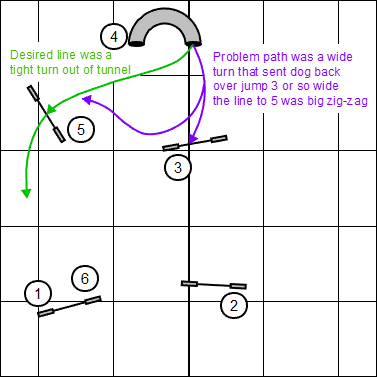
This past weekend I found a weak spot, a way too wide turn, while running an AKC master jumpers course with my young sheltie, Zabu. If the dog turned tight out of the C-tunnel, then the dog’s line was set to jump 5 (green path). If the dog turned wide, there were two problems: a back jump over jump 3 OR a zig-zag line to jump 5 which often caused the bar to come down.

My older dog turn tight on cue, but Zabu swung wide out of the tunnel despite my verbal cue. A weak spot like this doesn’t require a full 6 week training plan. It just needs to be “worked on”,  but how exactly does that happen? 

With maintenance issues, I am not doing a retrain or developing a new skill. I am reinforcing an existing skill. It is important to know and separate the two. However, I still take time to go back through the skill’s development. This helps me stay consistent in my training process.

To break this down, I look at the following: 

The cue I use needs to be consistent. For a tight tunnel turn, I use a simple verbal “Tunnel Come” which tells my dogs to turn tight. Whereas “Tun Tun Tun” tells them to go forward after a tunnel. Cue timing matters; my dog needs time to process my cue and initiate the desired behavior.

The behavior I want is a very tight turn out of the tunnel which means he looks for me immediately, rather than taking a stride forward before turning. So, I will click/mark only those turns where I see my dog’s eyes looking for me as he exits the tunnel. This reinforces his first stride after the tunnel is an efficient turn.

The reward will be on the tight line and will vary between a baited target and a tossed toy. 

A fundamental rule in animal training = rewarded behaviors get repeat. With a behavior that needs maintenance, I plan three training sessions with three different objectives to reinforce the behavior. 

Session #1 – isolate the behavior

Session #2 – put the behavior in a simple sequence

Session #3 – do a harder sequence that allows generalization and comparison to an alternative behavior.

Each session will have 3-5 reps.

I only progress to the next session if the dog has a high success rate, particularly on the first few repetitions. If the behavior is consistent only at the end of the session, then the weak behavior needs to repeat that session.

Only if your dog is successful does an increased frequency of rewards improve your dog’s competence and confidence in completing the cued behavior. Trust me, it’s worth spending the extra time and treats reinforcing the criteria you want to see on course.

I also pay attention to other factors that can impact my dog’s ability to complete the cued behavior.

For example, my dog might perform a behavior better on my left side or right side. The environment can also influence my dog’s performance; including distractions, the footing and equipment. To help, training sessions should be in various locations and spread out over a week or two.

With continued training my dog should have an improved understanding of the cue and behavior. Their success rate when completing the behavior should be between 90-100%.

More Training Tips

With your own training field maintenance training is easy. But, too often handlers are using course layouts in a rented space or can only train in a weekly class. To avoid just randomly throwing in a reward during “training” without having an exact plan, I have two suggestions.

1. Do your maintenance as a warm-up.

This is easy to do with tunnel issues,  contact criteria or when shoring up your dog’s response to a handling cue. In a warm-up situation, you can focus easily on one simple cue-behavior-reward pattern and can get multiple repetitions done quickly. 

2. Ask your instructor to help.

This is your training time, and most instructors are glad to help you train something specific, particularly if they asked you to “work on it”! Ask them to help you with your maintenance issues.

For example, instead of running the full course, ask to run a smaller section to allow you to reward where needed. You could quietly ask for an alternate path for your dog for one turn. You might also ask for an extra minute or two at the end of a class for a few minutes of  training time on a maintenance issue. You are training a simple behavior just a few good rewards will benefit your dog.